










How to Control Stretching of Cannabis Plants?


- 1. What happens when plants stretch?
- 2. Why do cannabis plants stretch?
- 3. How to prevent stretching of cannabis plants
- 3. a. Choose the right strain
- 3. b. Manage the heat
- 3. c. Reduce the vegetative period
- 3. d. Employ training techniques
- 4. In conclusion
Cannabis seeds grow very well without a lot of maintenance during their vegetative stage. They put out pretty green leaves and prepare for the reproductive or flowering stage. There isn’t a lot to do during the growing stage, but the flowering stage definitely requires maintenance.
From pests to diseases to stretching, there can be too many headaches to count. If you’re wondering how to control the stretching of cannabis plants, this article will show you simple steps that will help you harvest great yields. It’s not that the plants don’t stretch during the vegetative stage – they do – but it’s a lot more during the pre-flowering stage. Stretching is nothing but a natural spurt of growth and is common for all cannabis plants. However, it works only if it’s moderate. Stretch too much, and the plants start putting out thin, weak branches that cannot support bud weight when flowering comes.
On the other hand, when plants don’t stretch too much, you get thicker, stronger branching but fewer flowering sites, which can translate to lower yields. This means that one must control stretching to prevent loss of yield, not to mention quality.
Stretching occurs for multiple reasons, with genetics playing a role as well. This is why some plants, such as indica-dominant varieties, can be more easily kept short and compact, while sativa-dominant strains tend to grow tall and lanky.
So, if it’s 2026 and you’re wondering, “Is all hope lost?” No, not at all. You can prevent or encourage stretching in various ways, so let’s take a look at them.
1. What happens when plants stretch?
Stretching is not that big a deal if you’re growing plants outdoors. Like other plants, cannabis plants also enjoy growing outdoors, where you don’t have to worry as much since you don’t have much control over the environmental conditions.
However, a tool outdoor growers have is plant training techniques like LST.
That said, for the most part, stretching occurs when the plants are indoors. As mentioned already, stretching invites problems such as plants becoming spindly and leggy. When this happens, plants may not be able to develop a sturdy enough structure to support the weight of the buds once flowering begins. However, problems can arise even before the flowering stage, as a weak structure may prevent the plant from supporting its own weight, causing it to fall over.
When plants have access to proper light intensity, they grow stronger and develop a well-structured shape with greater overall strength.
In contrast, a lack of light post-germination causes plants to desperately shoot upwards.
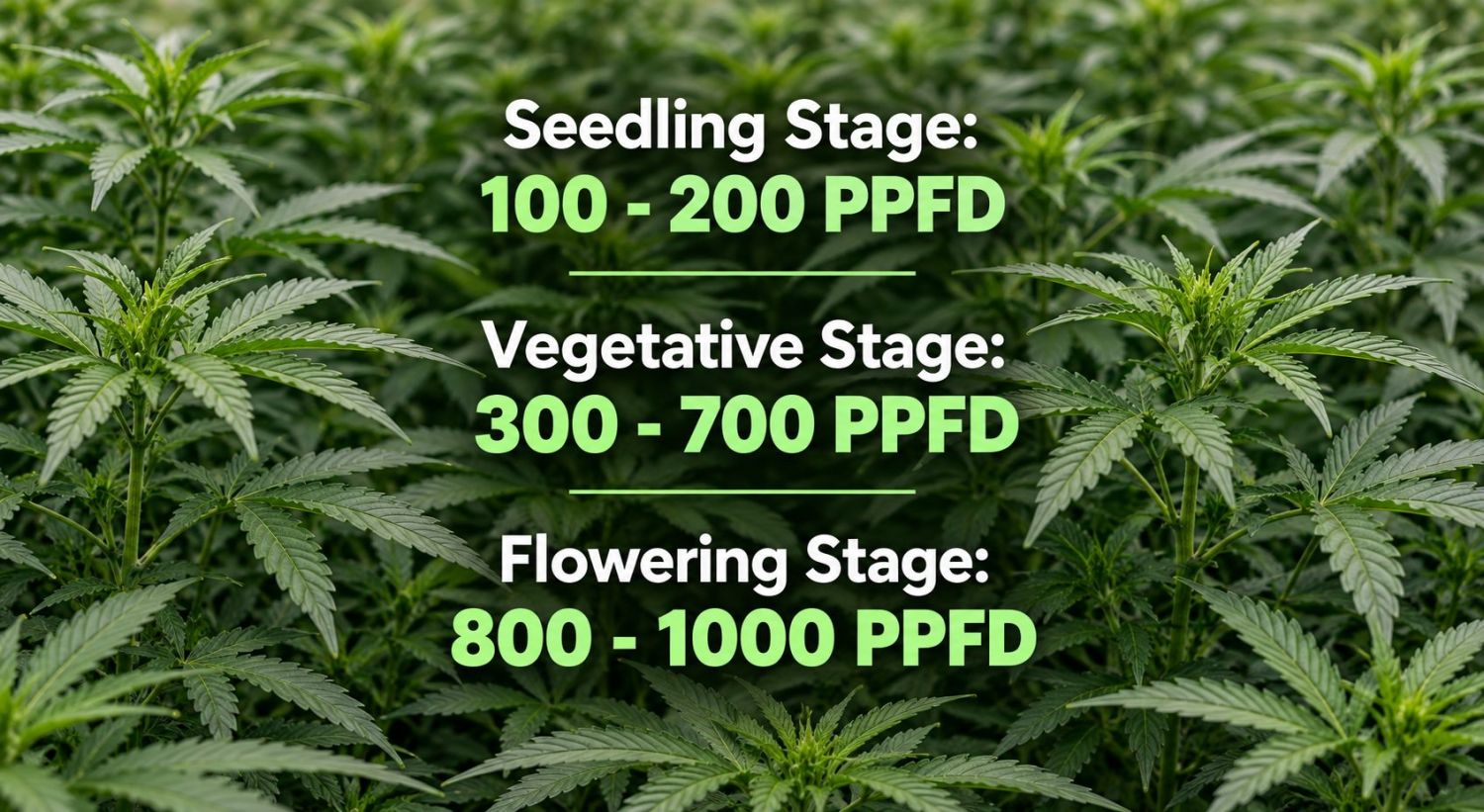
These conditions create a leggy seedling with a considerably long stem and tiny cotyledons and true leaves. When seedlings become excessively leggy, you might as well write them off. Their thin and weak stems won’t have what it takes to hold the weight of a vegging and flowering plant; the bottom of the stem will remain a weak link in the chain in the face of strong winds and other adverse weather events. To prevent stretching at this crucial time in the growing cycle, you need to provide adequate light intensity. To do this, you can use a PAR meter to measure PPFD levels, which should be:
- Seedling Stage: 100-200 PPFD
- Vegetative Stage: 300 - 700 PPFD
- Flowering Stage: 800 - 1000 PPFD
2. Why do cannabis plants stretch?
If the plants aren’t genetically inclined to stretch, they could be stretching due to the lights or heat, but mainly light intensity. If the distance between the plants and the lights is too far, the plants start growing upwards in search of more light. In an effort to go close to the source of light, the plants experience a growth spurt that’s otherwise known as stretching.
Stretching also occurs when there are too many plants in a grow room. If the grow room is overcrowded, the plants have no other option other than competing with each other for light. Last but not least, the type of light you use matters too. A more bluish spectrum will encourage vertical, vegetative growth, while a more reddish spectrum will encourage horizontal, flowering growth.
You can prevent this by supplementing blue light/red light when needed, or by utilizing full-spectrum LED lights.
If you don’t own a PAR meter, it’s recommended that you provide at least 50 to 70W of light per square foot, depending on the type of light (LED, HPS, CMH, CFL). Anything less than this will most definitely encourage the plants to stretch to their maximum. Certain strains are more predisposed to stretching. Genetics plays a vital role in determining exactly how a plant grows and will have the final say on the height of a plant. We, as cultivators, can control the stretch and overall height of a plant, but at the end of the day, we are still at the mercy of the plant’s genetics. Sativa-dominant plants are inherently more stretchy than their Indica-based siblings.
The idea here is not necessarily to prevent plants from stretching, but rather to allow them to stretch naturally instead of encouraging excessive stretching due to insufficient light or improper environmental conditions. Basically, the goal is to provide the right conditions for the plants to express their genetic potential.
3. How to prevent stretching of cannabis plants
Choose the right strain
Okay, this is the first thing you need to do because you can do everything and the plants will still stretch if it's in their genes. And this will happen even if you grow clones or plant seeds! Thus, find the right strains. Most Indica strains tend to grow sideways rather than upwards. At the same time, many Sativa strains are notorious for growing upwards.
This is not to say that tall plants are bad and short plants are better. Rather, it’s essential to choose strains that you can allow to grow to their full potential in your grow space without facing height-related issues. Ultimately, it all depends on how much horizontal and vertical space you have available.
Mango Frost Auto, for example, is a Sativa-dominant autoflower that finishes in just 8 weeks from start to finish while reaching no more than 110 cm in height.
Hybrid strains are ideal for those with limited space who are looking for a variety of effects and terpene profiles in a more manageable, compact format.
However, genetics will only get you so far. Any cannabis plant subject to a suboptimal light intensity will grow leggy, which means that you can’t get away with inadequate light intensity, regardless of the genetics that you select as a grower.
Manage the heat
When a lot of heat builds up in the grow room, the plants are forced to stretch upwards. Temperatures over 29 degrees C will force plants to grow taller. And as the plants grow closer to the light, they stretch even more. This makes them weak, and they can even fall over if you don’t keep an eye on them. To prevent this, make sure that there’s a lot of fresh air circulating in the grow room. Not only will it keep the grow room cool and the plants happy, but the plants will become stronger thanks to the breeze blowing in their direction. The plants naturally become stronger as a defense mechanism against the wind, as it happens in the wild. There are several ways that you can control the variable of heat within an indoor growing space.
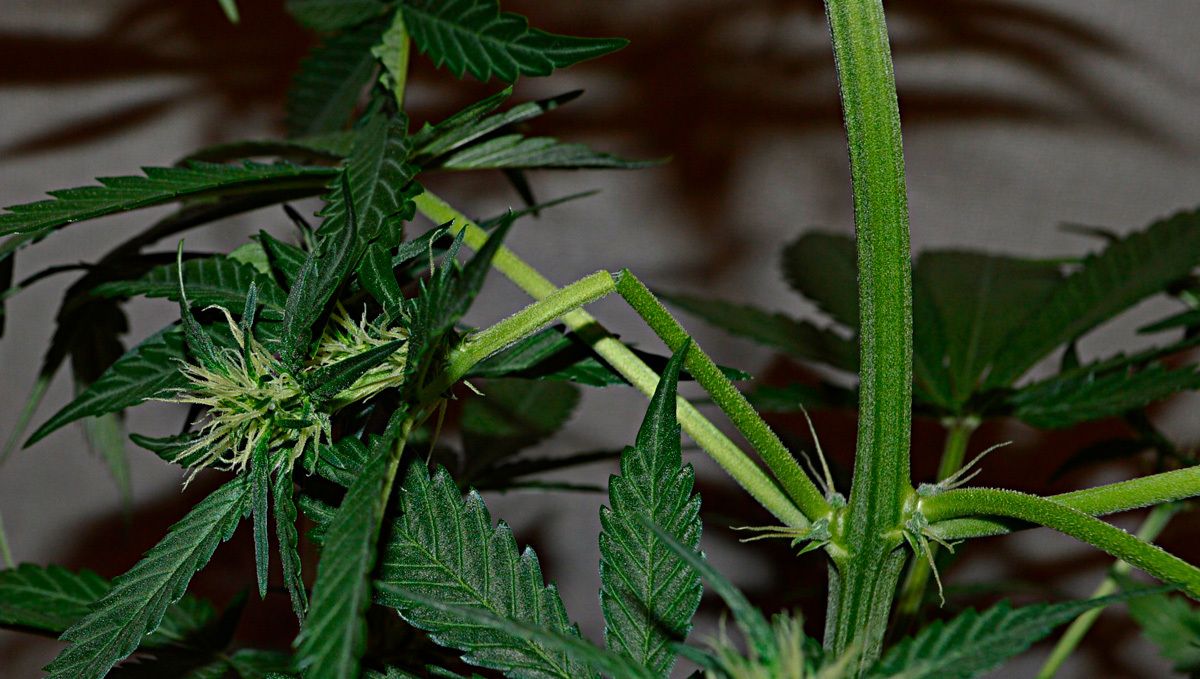
Obviously, fans will help to increase air circulation and cool things down. In more difficult situations, you might have to take more serious measures and switch on an air conditioning unit to keep temperatures down. Rather than constantly monitoring the temperature within your growing space, you can hook up your fans and air conditioning unit to a sensor to automate environmental regulation. Growers have a harder time keeping their plants cool outdoors. If you’re growing outdoors in a greenhouse or polytunnel, make sure you open up any vents and doors to promote airflow. During intense heat waves, set up sheets of shade cloth over your plants to protect them from excess UV rays.
Reduce the vegetative period
When plants start stretching during the vegetative stage, growers panic because there won’t be a lot of roof space for the plants to continue growing, especially after the pre-flowering stretch. Ultimately, they grow too close to the light and experience light-burn that bleaches the buds and leaves as well. If you’re growing a strain with a tendency to stretch, you can reduce the vegetative period so that there’s a lot of time and roof space for the plants to stretch into the flowering phase.
Growers growing photoperiod plants can switch from the vegetative to the flowering stage by altering the light schedule from an 18/6 light cycle to a 12/12 cycle. This isn’t necessary if you’re growing autoflowers because they will grow regardless of the light cycle. However, you can control stretching to a great extent by cutting the growing stage short so the plants have enough time and space ahead to stretch all they want.
Employ training techniques
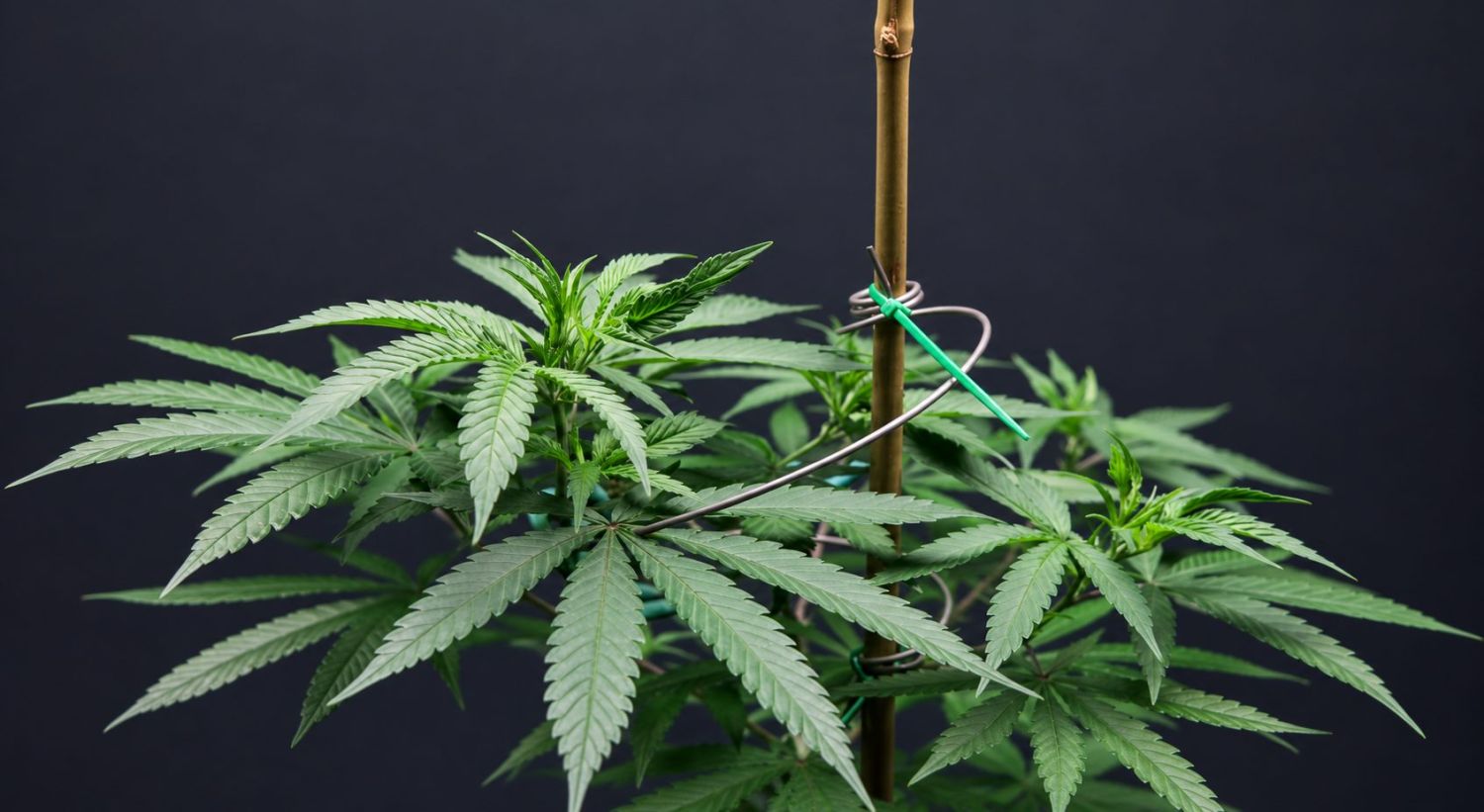
There are several techniques, including LST and SCROG, meant specifically to prevent cannabis plants from stretching.
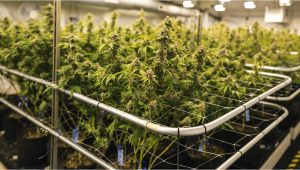
LST
Also known as Low-Stress Training, this method involves bending or tying the branches of the plants to the sides of the containers. Growers continue bending the branches throughout the growing cycle, and this prevents the plants from growing upwards. Yes, the branches try their best to stand upright, but they will remain bent if you use strong wires to fasten them to the sides and adjust the ties as needed.
SCROG
This is a method where the growers allow the plants to grow as much as they want in the vegetative stage. However, during the flowering stage, a screen is placed on top of the plants, where the branches are tucked in as soon as they try to peek out.
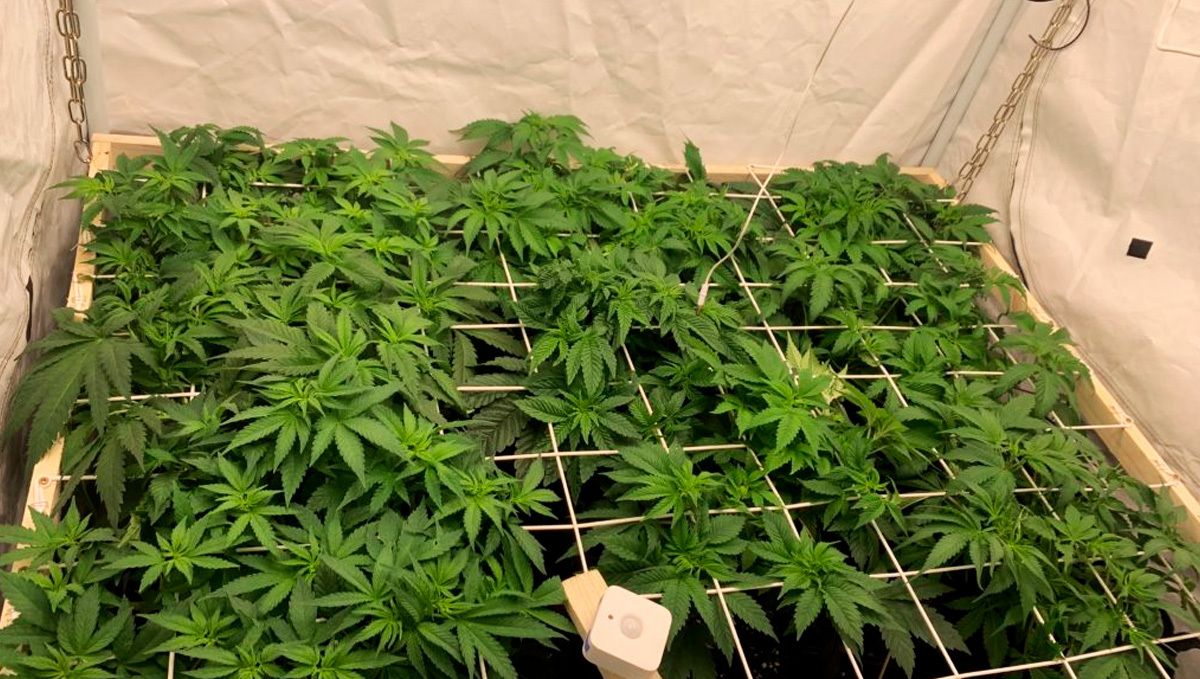
Known as Screen of Green, this technique prevents the plants from growing too much upwards, as the screen prevents them. You can remove all the leaves below the screen, but as you tuck the branches growing on top of the screen, you’ll notice many buds forming just because there’s an even canopy that allows uniform distribution of light.
Tips for Strong Plants
Even if plants don’t get stretchy, you may still have issues with weak stems and branches.
Outdoor gardens benefit from the natural air movement the environment provides, but with indoor cultivation techniques, we have to take that into our own hands. The air movement throughout the canopy has a direct and noticeable result on how thick and strong the branches and stems of your crop will eventually be.
Grow rooms with insufficient air movement will result in tall and spindly plants that will eventually need help to support the buds. To combat this issue, you can add a few oscillating fans into the grow area pointing at the canopy from different directions. If you have a small operation, then one fan should be just fine, but if you are running a larger tent or room, you should aim to have a fan pointing up into the canopy and at least one from the side. This way you have multiple air directions, which will help in that vigorous and thick stem growth we are looking for.
4. In Conclusion
So, as you can see, there are multiple ways to help your crop grow into the thick, dense bushes that we are all hoping for. With a little careful planning, you should have no problems achieving the yield of your dreams! Just remember that everything we expose our crop to can have an effect on the growth rate and, in turn, the final product. Happy growing, and good luck!
FAQ
Cannabis plants can stretch due to genetics, insufficient light, environmental conditions, competition for light, and their natural growth patterns. Stretching during the transition from the vegetative to flowering stages is also normal for many strains.
The pre-flowering stretch occurs throughout the pre-flowering stage, which typically lasts approximately two weeks. The exact duration and intensity depend heavily on the strain and growing conditions.
Generally, Sativa-dominant varieties tend to grow taller and develop greater internodal spacing, while Indica-dominant varieties are often shorter and bushier.
Unusually long distances between nodes, thin stems, and no side branching can be symptoms of insufficient lighting.
Yes. Excessive stretching can result in thin, weak stems that may struggle to support the plant’s foliage and eventual flower weight.
You can estimate it based on genetics, breeder information, and previous experience with the cultivar, but exact growth can vary depending on environmental conditions and individual phenotypes.
Look for genetics known for manageable heights and relatively compact growth. The important factor is choosing a cultivar whose expected size matches both the horizontal and vertical space available, or cutting the vegetative stage by a few weeks. However, in cases like this, autoflowers are highly recommended.
No. Neither growth pattern is inherently better. The “better” one depends on available space and the grower’s objectives. The goal is to provide enough room for the chosen genetics to express their potential without creating height-related problems.
No. Both autoflowers and photoperiods go through the pre-flower stretch. The amount of stretching depends largely on genetics and growing conditions rather than whether a plant is photoperiod or autoflowering.
Stretching can be managed by providing appropriate light intensity, maintaining suitable environmental conditions, selecting genetics that fit the available space, and managing the plant canopy with LST and HST training techniques.


Comments